Web of Science is one of the leading scientometric databases used for searching, analysing and evaluating scientific publications. The presence of an article in a journal indexed by this platform may indicate the high quality of the research, its compliance with international academic standards and the professional competence of the author. At the same time, choosing a journal for publication requires an understanding of the specific features of this platform. What is Web of Science? What functions does the platform offer? We will discuss this in our article.

What is the Web of Science database?
Web of Science (WoS) is one of the leading abstract and bibliographic databases in the world, operated by Clarivate. The platform contains scientific materials published as far back as 1864 and covers thousands of peer-reviewed journals from various fields of knowledge.
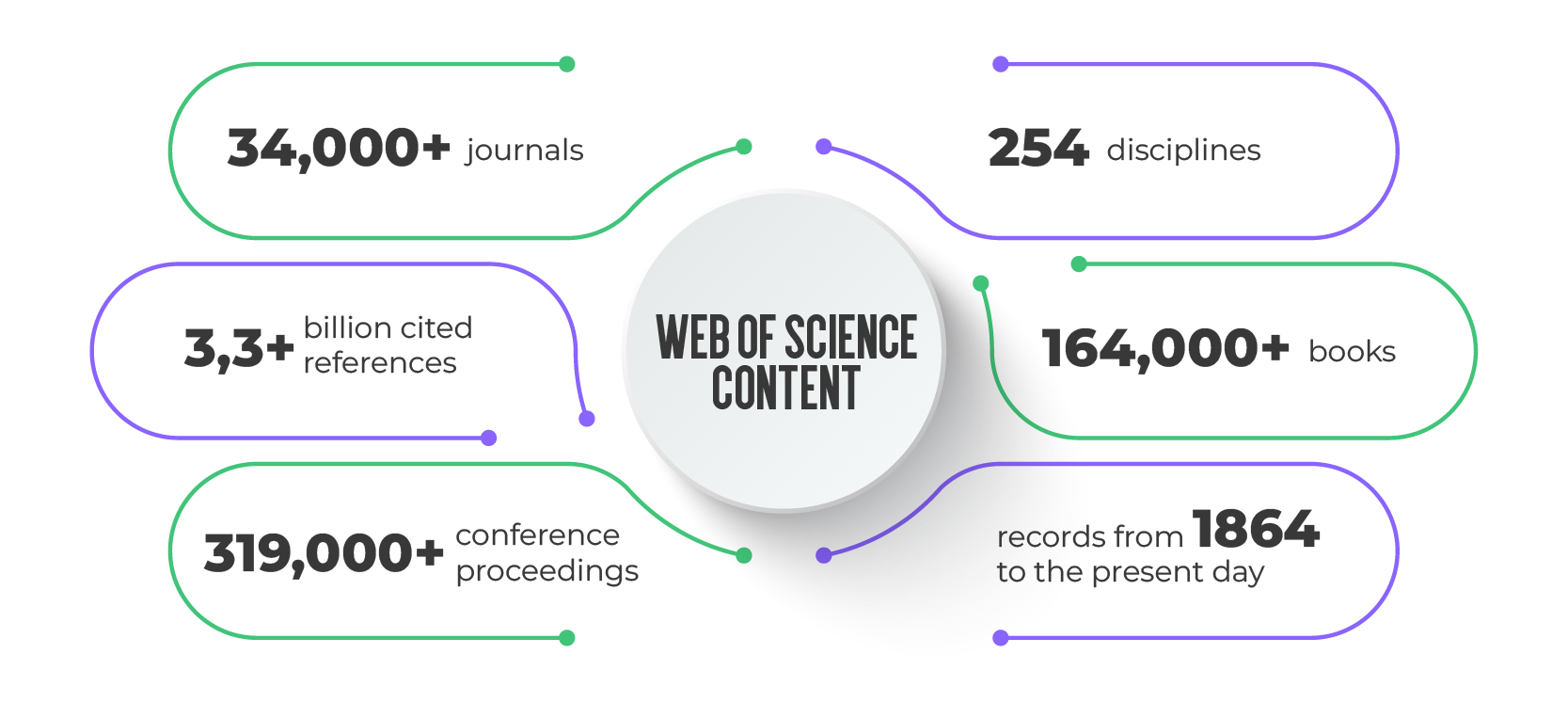
The platform covers scientific materials from various fields of knowledge; however, research of a technical nature is most prominently represented in it.
Web of Science disciplines
- physics
- biology
- mathematics
- medicine
- computer science
- chemistry
- engineering sciences
What functions does Web of Science offer?
Web of Science is a useful tool for searching scientific information, analysing sources and preparing high-quality research. The platform combines several important functions that help scientists work with scientific literature more systematically and effectively.
1. Search for scientific literature
Web of Science provides access to a large body of scientific materials, including articles, books, conference proceedings, patents and other academic sources. Thanks to its system of filters, researchers can search for publications by year of publication, author, keywords, subject area, document type and other parameters. This makes it possible to find relevant sources more quickly and select high-quality literature for further work on the research.
2. Information on the scientometric indicators of a journal
Web of Science provides data on the key scientometric indicators of journals, including the impact factor, quartile and other important metrics. This information helps researchers assess the level of authority of a publication, its influence in the scientific community and the appropriateness of choosing a journal for publishing their own article.
3. Citation analysis
Web of Science makes it possible to track the citation level of scientific publications and analyse how often certain studies are used by other authors. Thanks to this, researchers can identify the most relevant topics, see the dynamics of interest in specific areas and understand which works have the greatest influence in the scientific environment.
4. Access to specialised databases
Web of Science brings together several specialised collections, including SCIE, SSCI, AHCI and other databases, as well as resources with conference materials and patent information. This significantly expands the capabilities of the platform and gives researchers access to a broader range of scientific sources for searching, analysing and preparing their own research.
Do you want to publish an article in Web of Science? Contact Scientific Publications. Our specialists will provide you with support at all stages of the work: from selecting a journal to the moment of indexing. To receive a free consultation, fill in the form below, and our manager will contact you shortly. Together towards scientific achievements!