A strong project idea rarely wins a grant on its own – evaluation panels also weigh the applicant's track record and their capacity to work across borders. Why do publications with international co-authors carry so much weight in that assessment?
What counts as international co-authorship in a grant application?
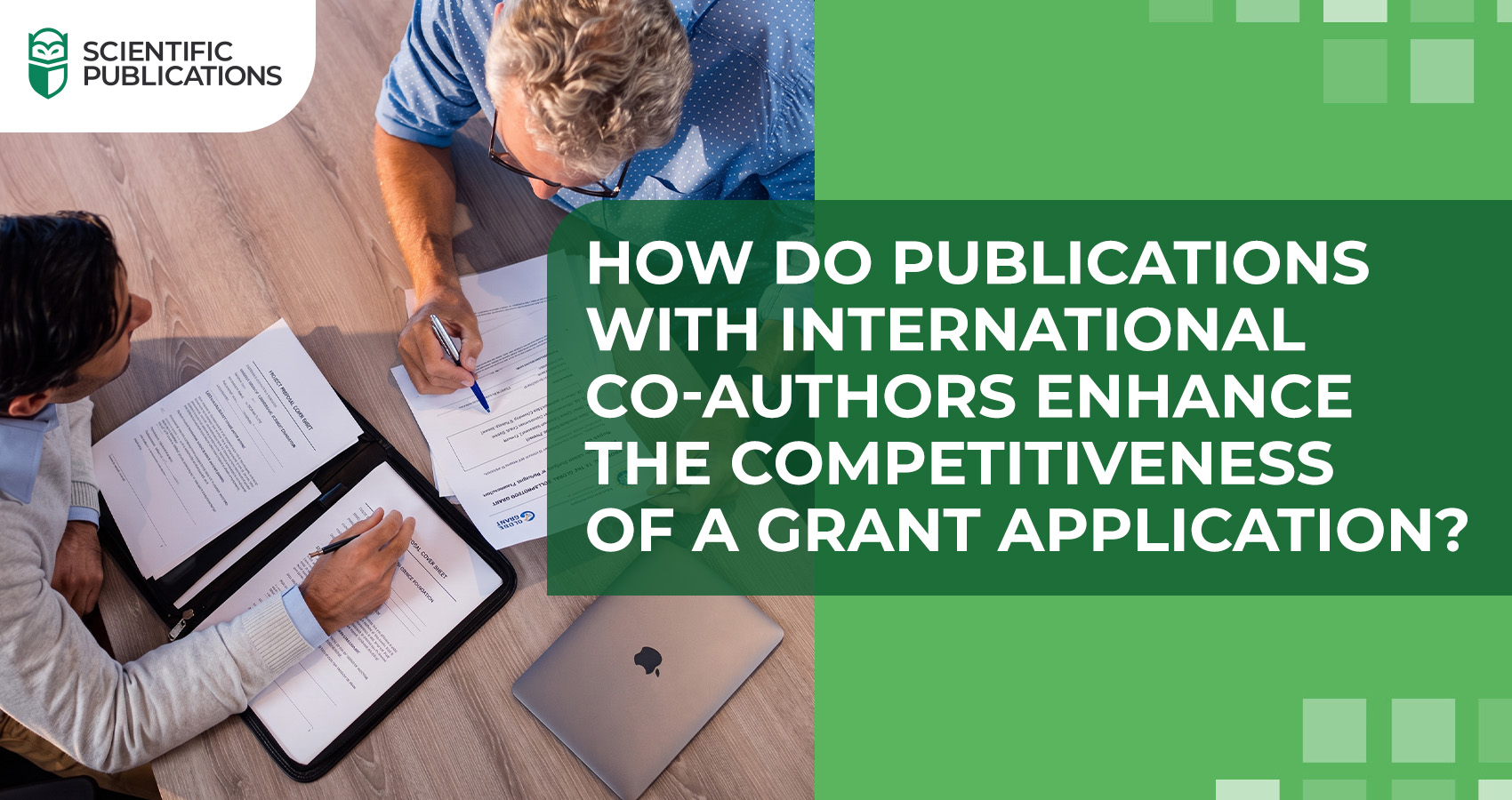
International co-authorship refers to a publication whose authors are affiliated with institutions in at least two different countries. For a grant application, what matters is not the geography of the topic but the composition of the author list: a genuine research contribution from a partner abroad, reflected in the paper's affiliations, carries more weight with reviewers than a token acknowledgement. Co-authorship of this kind is usually documented through the article's affiliation line, its ORCID records and, where relevant, a statement of each author's contribution.
International co-authorship strengthens a research track record
Funding bodies assess an applicant largely through their prior publications, and a paper written with partners abroad is read as evidence of several things at once. It performs a number of practical functions:
- gives access to data, samples or equipment unavailable at the home institution
- introduces methods and analytical approaches beyond the applicant's own field
- extends the paper's readership and citation reach beyond the domestic academic community
- lays the groundwork for future joint proposals with the same partner institution
Reviewers who see this pattern across several publications, rather than a single isolated paper, tend to read it as a stable working relationship rather than a one-off arrangement.
How do funders read international co-authorship on a CV?
A number of studies on grant outcomes point to the same pattern: the quality and international visibility of an applicant's prior publications is among the strongest predictors of a proposal's success. Reviewers use this evidence to judge whether the applicant can coordinate work across institutions, a skill that is difficult to assess from the proposal text alone.
Programmes such as Horizon Europe go further and require a multi-country consortium by design, so a demonstrated history of cross-border collaboration becomes a condition of eligibility rather than an advantage. National and regional funding bodies across the Arab world increasingly apply similar reasoning even where a foreign partner is not formally required, treating an established international network as a sign that a project can be delivered on the scale it proposes.
Building international co-authorship before a grant deadline
Because a publication record cannot be built overnight, this part of an application benefits from planning well ahead of the submission date. A practical sequence looks as follows:
- Identify a partner institution whose expertise complements the project's methodology.
- Agree on the terms of the collaboration, including authorship order and data-sharing, before the joint work begins.
- Aim to publish at least one joint output ahead of the deadline, allowing for the target journal's review timeline.
- Reference the collaboration explicitly in the track-record section of the proposal, rather than leaving reviewers to infer it from the affiliation list.
Left until the final weeks before submission, most of these steps cannot be completed in time, which is why funders tend to reward applicants who treat international collaboration as an ongoing practice rather than a late addition to the file.
International co-authorship does not replace a sound research design, but it gives reviewers concrete evidence that an applicant can deliver on the scale a grant requires. Built up gradually through genuine joint work rather than symbolic inclusion, it remains one of the more reliable ways for a proposal to stand out among the pool of applications competing for the same funding.
If you are planning a scientific publication, contact Scientific Publications. We can help you select a suitable journal, check whether your article meets its formatting and ethical requirements, and support you at every stage of the submission and review process. Would you like a free consultation? Fill in the form below, and our manager will contact you shortly. Together towards new scientific achievements!