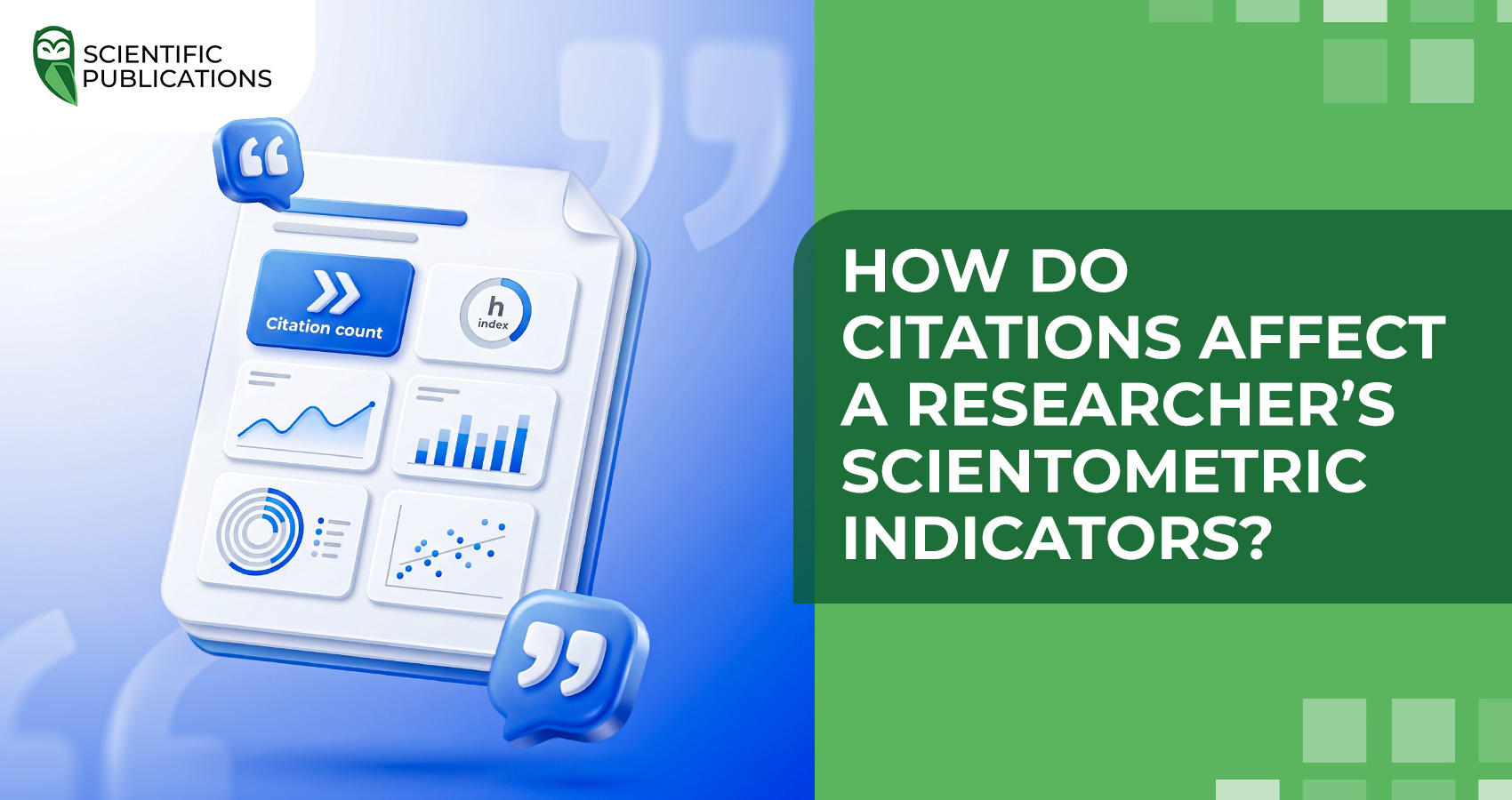
After a scientific article has been published, it is important to monitor the number of citations it receives. This indicator may demonstrate the academic community’s interest in the research and the use of its results in subsequent studies. It also affects the formation and growth of certain scientometric indicators of a researcher. How exactly does citation affect these metrics? We examine this in detail in our article.
What can the citation rate of a researcher’s works indicate?
Citation is one of the indirect indicators of the scientific impact of an author and their research. In particular, the number of citations shows how many times a researcher’s work has been referenced in other scientific publications.
An increase in citations may help improve an article’s visibility within the academic community. In other words, the more frequently research findings are applied, discussed or criticised in other works, the wider the audience the publication may reach.
At the same time, a large number of citations does not in itself guarantee the quality of a study, so this indicator should not be relied upon alone. Instead, it should be assessed together with the content of the publication, the author’s contribution and the specific characteristics of the scientific field.
Which of a researcher’s scientometric indicators are affected by citation?
Total number of citations
Each reference to a publication recorded in the relevant database increases the author’s total citation count. A high citation rate, in turn, may indicate the visibility of the researcher’s works and their use within the academic community.
However, it should be taken into account that each database covers different sources. This is why the total number of citations may differ across Scopus, Web of Science and Google Scholar.
h-index
For the formation of the h-index, it is important that several of the author’s publications receive a sufficient number of citations, rather than just one individual work.
To calculate an author’s h-index, their articles must be arranged from the most cited to the least cited. The number of citations must be equal to or greater than the publication’s position in the list.
For example, if a researcher has five articles, each of which has been cited at least five times, while the sixth has been cited only four times, their h-index will be five. An increase in the number of citations received by one individual work does not guarantee an immediate rise in the h-index. In other words, if a particular article has been cited 10 times while the author’s other publications are hardly cited, this will not result in an h-index of 10.
More information about the factors that affect the h-index and ways of increasing this indicator can be found in our previous article.
i10-index
The i10-index is used in Google Scholar profiles and is not one of the standard metrics used by Scopus or Web of Science. A distinctive feature of this indicator is that it shows the number of an author’s publications that have received at least ten citations. In other words, if a researcher has 15 works but only nine of them have been cited ten or more times, their i10-index will be nine.
This indicator increases whenever one of the author’s publications reaches the threshold of ten citations. If an article has already been included in the i10-index, any further citations it receives will not change the value of the metric.
Therefore, citation is important for the formation of an author’s scientometric indicators, including the total number of citations, the h-index and the i10-index. At the same time, it is incorrect to evaluate an author’s academic activity solely on the basis of these metrics. The quality, originality, relevance and practical value of the research should also be taken into account.
If you are experiencing difficulties in increasing your h-index or other indicators, contact the Scientific Publications company. Our specialists will analyse your profile and develop an individual strategy for increasing the number of citations. Submit an enquiry on our website, and our manager will contact you shortly. Together towards new academic achievements!