The Hirsch index is one of the main indicators that help assess the research activity of scientists. In particular, it reflects the effectiveness of a researcher’s work and the impact of their studies on the academic community. The h-index is influenced by many factors: from the scientific field to the database in which the articles are indexed. What indicator is considered good for PhD students? Read our article.
What is the h-index?
The Hirsch index (h-index) – is a scientometric indicator developed by the American physicist Jorge Hirsch in 2005. It is currently actively used to assess the effectiveness of researchers’ scientific activity. Among the main advantages of the h-index are the following:
- objective assessment of a scientist’s research impact
- formation of the researcher’s international visibility
- increased trust in the scientist
- exclusion of the factor of accidental success
How is the h-index calculated?
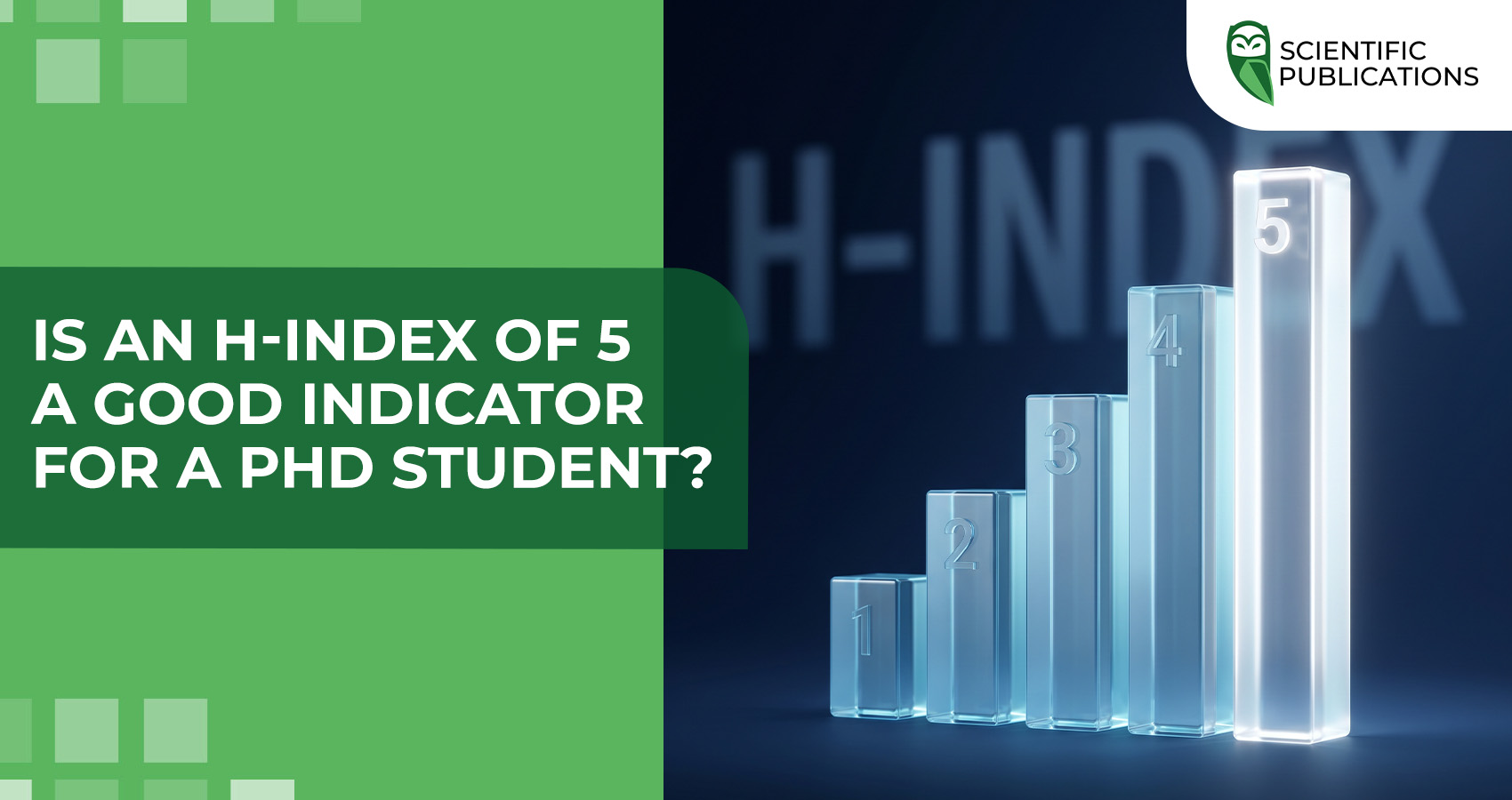
When calculating the Hirsch index, two important criteria are taken into account: the number of scientific articles and the number of their citations. This scientometric indicator means that a scientist has h papers, each of which has been cited at least h times. That is, if the h-index equals five, it means that five of the researcher’s articles have received at least five citations each.
To calculate the Hirsch index, it is necessary to follow these steps:
- Make a list of all scientific works.
- Count the citations for each article.
- Arrange all works in descending order by the number of citations.
- Find the last article on the list whose number is less than or equal to the number of its citations. This number can be considered the Hirsch index.
Learn more about the importance of the h-index for scientists’ activity in our article.
Why do PhD students need the h-index?
At the beginning of their career, it is important for PhD students to develop their research profile and gradually build their reputation in the academic community. The h-index can help with this, as it confirms publication activity and demonstrates the impact of a researcher’s studies.
The main advantages of this indicator for PhD students also include:
- increased chances of obtaining grants, winning competitions and participating in internships
- increased international visibility
- career development after postgraduate studies
What h-index is good for PhD students?
It is practically impossible to determine a universal Hirsch index for PhD students. The norm of the indicator may vary depending on the field, the number of publications, the database and a number of other aspects. At the beginning of a researcher’s academic career, a low h-index or even its absence is considered completely normal.
We suggest considering the possible h-index indicators for a PhD student and their key meaning.
| h-index | Meaning for a PhD student |
| 1-2 | Not bad at the start of scientific activity, as this indicator shows the presence of works that have already begun to be cited. |
| 3-4 | Such an h-index is considered quite good for a PhD student, especially if their publications are indexed in Scopus or Web of Science databases. |
| 5+ | This is a strong indicator for a PhD student, reflecting their publication activity and existing citation level. |
Is an h-index of 5 a good indicator for a PhD student?
A Hirsch index of 5 means that the researcher has published at least five articles, each of which has been cited no fewer than five times. This indicator demonstrates a successful start to scientific activity.
At the same time, it is important to take the field of research into account. For example, in medicine, biology or chemistry, citations accumulate quite quickly, so an h-index of 5 is a good indicator for a PhD student. In contrast, in the humanities and some applied sciences, citations usually accumulate more slowly. Achieving a Hirsch index of 5 in these fields is a noticeable achievement not only for a PhD student, but also for experienced lecturers.
It should also be taken into account which database, for example Scopus or Web of Science, is used to calculate this indicator, as its value may differ depending on this.
The Hirsch index is indeed important for scientists, especially at the beginning of an academic career. If a PhD student aims to increase this indicator, it is worth focusing on improving the quality of scientific works, choosing relevant research topics, publishing in quality journals and building effective scientific communication.
Are you having difficulties increasing your Hirsch index? Contact Scientific Publications. Our specialists will analyse your research profile and select a strategy for increasing the number of citations. Leave a request in the form below, and our manager will contact you shortly.