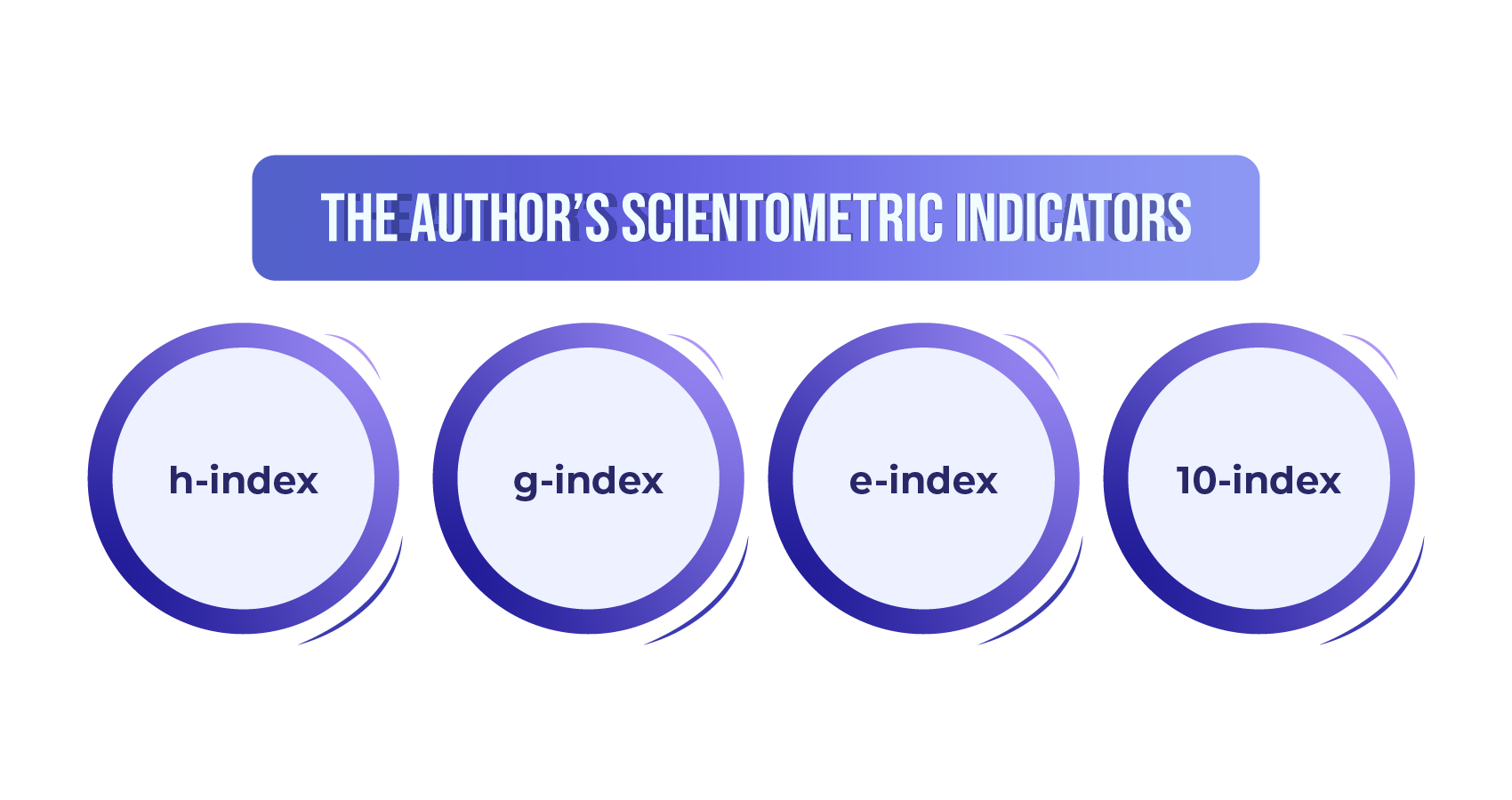
Scientometric indicators are quantitative measures used to analyse a researcher’s publication activity and citation impact. These include the number of publications and citations, the h-index, g-index, e-index and i10-index. In our article, we will examine these key metrics and explain their specific features.
Number of publications and citations
When analysing a researcher’s activity, attention is primarily paid to the number of their publications and citations. These data are also used to calculate a range of other scientometric indicators.
The number of publications reflects how many of an author’s scientific works are represented in a particular database. In turn, the citation count indicates how often other researchers have referred to the researcher’s work.
It is worth adding that the values of these indicators may differ across Scopus, Web of Science and Google Scholar, as these platforms have different levels of source coverage.
Hirsch index
The h-index takes into account both the number of an author’s publications and their citation impact. For example, a Hirsch index of 10 means that a researcher has at least 10 works, each of which has received no fewer than 10 citations.
This is one of the most widely used indicators of an author profile. It reflects a researcher’s productivity and the impact of their publications on the academic community. The Hirsch index may be taken into account by educational institutions, grant-awarding bodies, scientific organisations and other institutions when assessing a candidate. At the same time, it is important that the h-index should not be the sole criterion.
In our previous article, we explained in greater detail what h-index is considered good for researchers.
g-index
This indicator complements the Hirsch index and makes it possible to take better account of the impact of an author’s most highly cited works. The main difference is that the g-index is based on the cumulative number of citations received by the publications with the highest citation levels.
To calculate it, the materials must be arranged in descending order according to the number of citations, after which their citation counts are gradually added together. The indicator is equal to the largest number g for which the first g publications have received at least g² citations in total. In other words, a g-index of 5 means that an author’s five most highly cited works have received no fewer than 25 citations in total. At the same time, the condition for the next value of the indicator is not met.
e-index
The e-index is a supplementary metric considered alongside the Hirsch index. Its key feature is that it takes into account the ‘excess’ citations of the group of works on which the h-index is based.
Researchers with the same h-index may have different e-index values because of differences in the number of excess citations. Therefore, this metric may be useful for comparing authors’ citation impact.
i10-index
The i10-index is a scientometric indicator used primarily in Google Scholar profiles. It reflects the number of an author’s publications that have received at least 10 citations.
For example, an i10-index of 7 means that an author has seven works, each of which has been cited no fewer than 10 times.
It is important to remember that an author’s scientometric indicators may differ depending on the database in which their works are indexed, the scientific field, the types of publications, the length of their career and other factors. Therefore, despite all the advantages and possibilities offered by digital metrics, they should not be used as the sole basis for assessing a researcher’s activity.
Have you encountered difficulties in increasing your h-index or other indicators? Contact the company Scientific Publications. Our specialists will provide qualified support and help you take all requirements into account. Submit an application on the website, and our manager will contact you shortly. Together towards new scientific achievements!